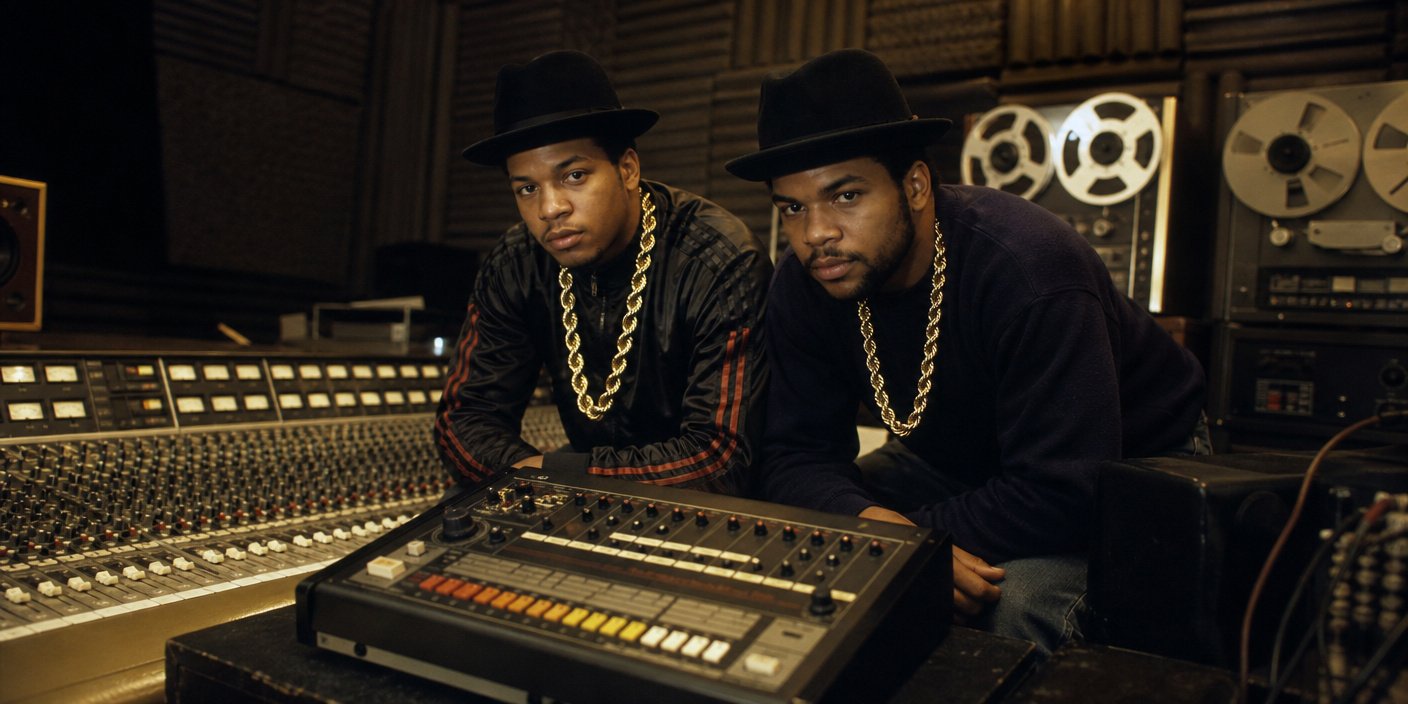
On March 12, 1983, the trajectory of hip hop changed forever with the release of Run-D.M.C.’s debut single, “It’s Like That.” Before this pivotal moment, the genre was often characterized by live disco bands, elaborate horn sections, and party-centric lyrical themes. Run-D.M.C., however, stripped the sound down to its bare, skeletal essence—a drum machine beat, a simple vocal flow, and the raw energy of New York City streets. Today, we celebrate the 43rd anniversary of a track that did not just climb the charts; it established the blueprint for what we now recognize as modern hip hop.
Key Highlights
- Historical Shift: “It’s Like That” marked the definitive transition from the “disco-rap” era of the late 70s to the minimalist, street-oriented “new school” of the 80s.
- Production Mastery: The track famously utilized the Roland TR-808 drum machine, effectively proving that a human band was no longer a requirement for a hit record.
- Lyrical Authenticity: Unlike their predecessors, Joseph “Run” Simmons and Darryl “D.M.C.” McDaniels delivered socially conscious, reality-based rhymes that reflected the harsh environment of 1980s New York.
- The Double A-Side: The single was released as a double A-side with “Sucker M.C.’s,” a track that solidified the group’s lyrical dominance and competitive edge in the burgeoning hip hop industry.
The Minimalist Manifesto: A Sonic Revolution
When listeners first heard the opening bars of “It’s Like That” in 1983, the impact was immediate. The production, spearheaded by the legendary team of Russell Simmons and Larry Smith, rejected the lush, expensive instrumentation that had dominated earlier successes like The Sugarhill Gang’s “Rapper’s Delight.” Instead, “It’s Like That” was built upon a sparse, thumping Roland TR-808 beat. This sonic austerity was not a byproduct of budget constraints; it was a conscious artistic choice. It forced the audience to focus entirely on the rhythm and the voice, stripping away the artificial gloss of disco to reveal the truth of the streets.
The Death of the Disco Backing Track
Prior to 1983, many rap tracks were recorded by studio musicians mimicking the styles of popular disco and funk bands. While successful, this approach kept hip hop tethered to the constraints of traditional song structures. Run-D.M.C. shattered this tether. By utilizing a programmable drum machine, they created a sound that was undeniably “hip hop.” The 808 beat was infectious, but more importantly, it was flexible. It allowed the rappers to dictate the tempo and the flow without waiting on a live drummer. This technological shift enabled the “new school” era to flourish, as producers across New York—and eventually the world—realized that they could build entire tracks in a bedroom or a small studio without the overhead of a full ensemble.
Reality Rap: A Window into 1983 New York
The lyrical content of “It’s Like That” was equally transformative. While other rappers were focused on party anthems, Run-D.M.C. addressed the anxieties of the era. The lyrics explored poverty, unemployment, and the general social decay of the Reagan administration’s early years. The group didn’t just rap; they reported on the reality they saw from their porches in Hollis, Queens. By adopting a dead-serious, authoritative tone, they signaled that hip hop was not just entertainment—it was journalism. They were the voice of a generation that felt ignored by mainstream media, making the “new school” sound feel dangerous, authentic, and utterly necessary.
The Double A-Side Strategy: Marketing Genius
The inclusion of “Sucker M.C.’s” as the flip side of the 12-inch vinyl was a stroke of genius that served a specific purpose: to establish the group’s competitive dominance. If “It’s Like That” was the conscious reflection of their world, “Sucker M.C.’s” was the battle cry. It featured a stripped-back, drum-heavy production that allowed the duo to showcase their technical rhyming prowess. By releasing both simultaneously, the group achieved two distinct goals: they tapped into the social consciousness of the streets and they established themselves as the elite lyricists of the scene. This dual approach became the gold standard for hip hop marketing throughout the decade.
Legacy and Modern Influence
Looking back 43 years later, it is difficult to overstate the importance of “It’s Like That.” It paved the way for groups like Public Enemy, whose own brand of socially charged, production-heavy hip hop would follow in the late 80s. It forced the music industry to take hip hop seriously, transitioning it from a “fad” to a cultural powerhouse. Every time a modern rapper uses a skeletal 808 beat to make a point, or a producer favors minimalism over excess, they are channeling the ghost of the Run-D.M.C. debut.
FAQ: People Also Ask
Q: Why was the TR-808 drum machine so important to the sound of ‘It’s Like That’?
A: The TR-808 provided a deep, distorted, and punchy bass sound that defined the 80s hip hop aesthetic. It replaced the need for live percussion, allowing for a harder, more driving rhythm that complimented the aggressive, direct vocal style of Run-D.M.C.
Q: What was the main difference between the ‘Old School’ and the ‘New School’ eras of hip hop?
A: The ‘Old School’ (late 70s) was characterized by live bands, disco-funk influences, and party-based themes. The ‘New School’ (early-to-mid 80s) introduced minimalism, electronic drum machines, harder street imagery, and a focus on lyrical technicality and social commentary.
Q: Who produced Run-D.M.C.’s debut single?
A: The single was produced by Russell Simmons, the group’s manager and co-founder of Def Jam Recordings, along with the legendary producer and musician Larry Smith, who was instrumental in shaping the group’s early, hard-hitting sound.
Q: Did ‘It’s Like That’ immediately make Run-D.M.C. famous?
A: Yes. While it was their debut, it reached number 15 on the Billboard R&B chart, signaling to the industry that the group—and the new, harder sound of hip hop they represented—was a commercial and critical force to be reckoned with.