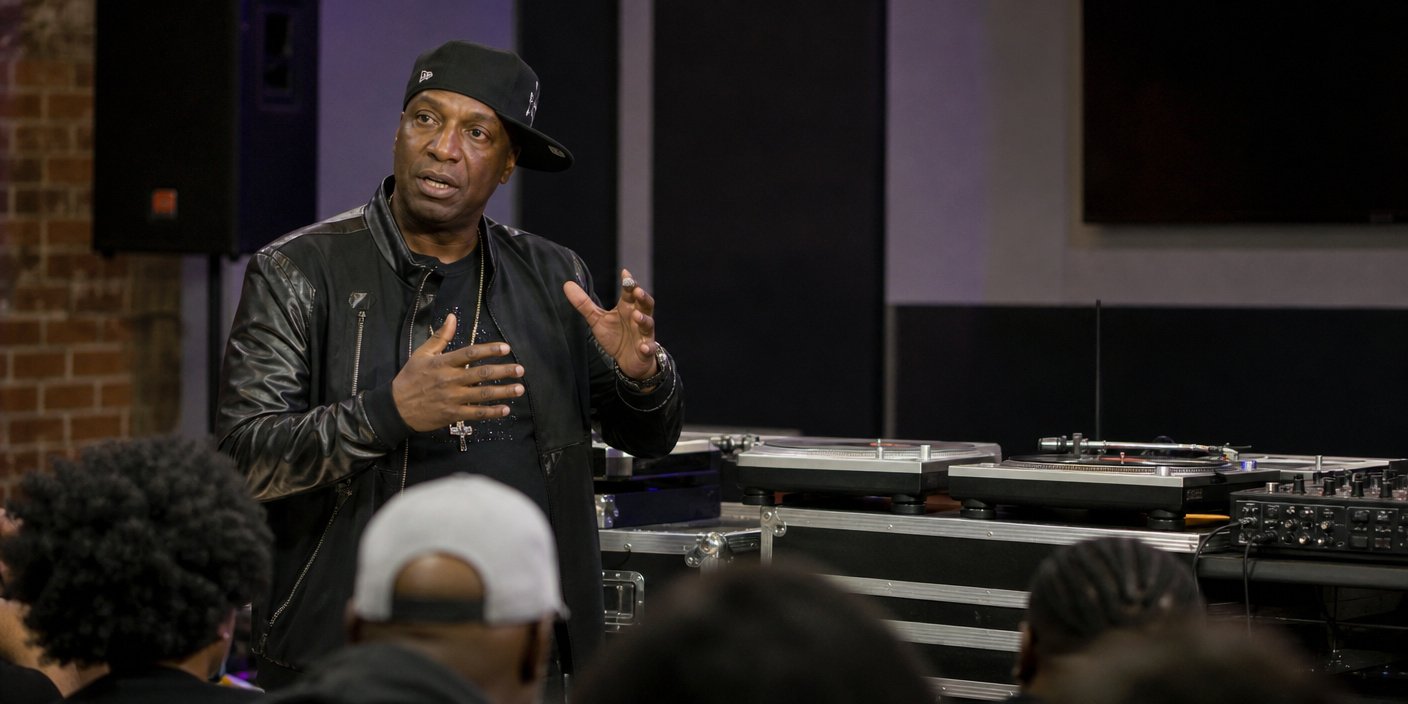
Grandmaster Flash, the legendary innovator whose hands first turned the turntable into an instrument, is continuing his mission to formalize the history of hip-hop. With the release of his seminal book, ‘The Birth of a Culture,’ the Hall of Fame DJ is providing a masterclass in the technical mechanics that fueled the genre’s explosive origins. As part of a national engagement tour, Flash is hosting an official book signing in Atlanta today, inviting fans and historians to examine the granular science behind the beats that changed popular music forever.
- Definitive Archival Work: ‘The Birth of a Culture’ serves as a visual and technical roadmap of early hip-hop, documenting the gear, the setups, and the DIY methodology of the 1970s Bronx.
- Technical Innovation: The book emphasizes Flash’s ‘Quick Mix Theory,’ detailing the precise physical movements and crossfader adjustments required to keep the dance floor moving.
- Atlanta Engagement: Today’s event in Atlanta marks a critical stop in Flash’s mission to educate a new generation of producers and DJs on the roots of their craft.
- Institutional Legacy: Grandmaster Flash continues to push for hip-hop’s recognition as a disciplined, scientific, and highly technical art form, moving beyond its perception as purely performance-based entertainment.
The Technical Genesis of Hip-Hop
To understand the evolution of contemporary music, one must first understand the laboratory of the South Bronx in the 1970s. Grandmaster Flash (born Joseph Saddler) was not merely a performer; he was an electrical tinkerer. Before the era of digital workstations and beat-matching software, Flash was physically dismantling turntables to understand the signal flow of the audio equipment. His approach, often referred to as ‘The Quick Mix Theory,’ wasn’t just artistic—it was a rigorous application of physics and electrical engineering to the turntable.
In ‘The Birth of a Culture,’ Flash pulls back the curtain on these early innovations. The book provides an unprecedented look at how he navigated the limitations of the era’s audio equipment. By calculating the exact moment a beat would drop and creating a physical methodology for looping those sections, Flash laid the groundwork for what would become modern sampling. For Flash, the DJ booth was a workspace, and the records were components in a larger, rhythmic circuit board. This book functions as a technical manual for that era, capturing the raw, unpolished energy of the block party while contextualizing the sheer precision required to sustain a beat for hours.
The Anatomy of ‘The Birth of a Culture’
What sets this release apart from standard music memoirs is its focus on the archival evidence of the culture. Flash has curated a collection of photographs, diagrams, and personal artifacts that detail the specific gear used during the formative years of hip-hop. It addresses the ‘why’ and ‘how’ of the music’s development rather than just the ‘who.’
Readers are given a granular view of the crossfader modifications—a modification Flash pioneered to allow for instantaneous switching between two turntables. This simple, elegant mechanical change was the ‘Big Bang’ of hip-hop production. By showing these blueprints in the book, Flash is effectively institutionalizing the trade secrets that were once passed down only through local apprenticeship. He treats hip-hop history with the same academic seriousness typically reserved for classical music theory, proving that the ‘break’ was a mathematical discovery as much as a cultural one.
Atlanta as a Cultural Hub
Choosing Atlanta for this specific signing is significant. While the genre was born in New York, Atlanta has served as the undisputed engine of hip-hop’s commercial and sonic evolution for the last three decades. By bringing this historical deep dive to Atlanta, Flash is bridging the gap between the pioneers of the Bronx and the modern-day masters of the genre who call the South home.
This event is not just a standard book signing; it is a convergence of generations. It provides an opportunity for Atlanta’s thriving creative community to interact directly with the man who invented the foundational software of their industry. Discussions at the event are expected to center on the transition from analog turntablism to digital production, and how the fundamental ‘science’ Flash developed remains present in the DAWs (Digital Audio Workstations) used by today’s chart-topping producers.
Preserving the Legacy
Beyond the event in Atlanta, the broader goal of this project is preservation. Grandmaster Flash has long been a vocal advocate for recognizing hip-hop’s place in the broader spectrum of American history. With the rise of digital misinformation and the loss of oral histories, ‘The Birth of a Culture’ acts as a primary source document.
Flash’s methodology encourages historians and fans to treat the music not as a ephemeral cultural phenomenon, but as a discipline that requires mastery of mechanics, timing, and innovation. As he travels from city to city, the dialogue is shifting: we are no longer just asking about the stories behind the songs, but about the technical processes that made the songs possible in the first place. For Flash, the science of hip-hop is an ongoing project, and this book is merely the next step in establishing a permanent record for future generations to study.
FAQ: People Also Ask
1. What is ‘The Birth of a Culture’ about?
It is a definitive book by Grandmaster Flash that chronicles the technical and cultural origins of hip-hop, featuring rare photos and technical diagrams of the gear and techniques he pioneered in the 1970s.
2. What is the ‘Quick Mix Theory’ mentioned by Grandmaster Flash?
It is a technical methodology developed by Flash that involved precise physical manipulation of turntables, including crossfader techniques and beat-matching, to seamlessly loop breakbeats.
3. Why is the Atlanta book signing significant?
Atlanta is a powerhouse of contemporary hip-hop, and bringing this history to the city serves to bridge the gap between the genre’s New York origins and its modern-day production dominance.
4. Is this book a memoir or a history book?
It functions as both, but with a unique focus on technical documentation, offering a ‘science’ of hip-hop perspective that contrasts with traditional celebrity biographies.