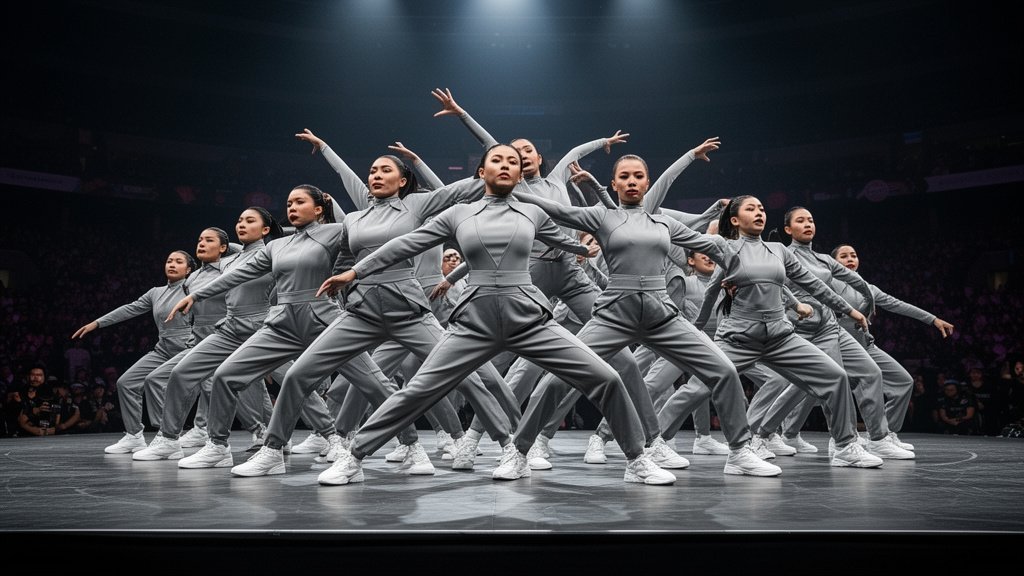
In an electrifying finale that has redefined the competitive landscape, the Manila-based all-queer dance collective Femme MNL has secured the gold medal in the Megacrew Division at the 2026 Hip Hop International (HHI) World Championship. The victory marks a monumental shift in global street dance, as the group’s performance was lauded not just for its technical execution, but for its unique narrative structure and thematic cohesion, setting a new benchmark for what is expected in one of the most grueling categories of the competition.
Key Highlights
- Historic Win: Femme MNL secured the Megacrew Division gold medal at the 2026 Hip Hop International World Championship, besting a field of top-tier international crews.
- Technical Mastery: The group’s routine scored a record-breaking average in the ‘Musicality’ and ‘Creativity’ metrics, the two most heavily weighted components of the HHI scoring rubric.
- Cultural Impact: As an all-queer collective, Femme MNL’s rise to the top of the podium highlights the increasing influence of diverse, identity-driven narratives within professional street dance.
- Global Recognition: This win solidifies the Philippines’ growing dominance in the international dance circuit, further cementing the nation’s reputation as a powerhouse in the global hip-hop community.
A New Era of Choreography: Inside Femme MNL’s Winning Performance
The Hip Hop International World Championship has long been the crucible of professional dance, where crews from over 50 countries converge to test the limits of physics, rhythm, and artistic expression. For the 2026 Megacrew Division, the stakes were elevated. Unlike the smaller, more agile teams in the Varsity or Adult divisions, the Megacrew category requires the synchronization of 15 to 40 dancers—a logistical and creative challenge that often separates the amateur from the elite.
Femme MNL’s approach to the 2026 competition was distinctly unconventional. While many crews focused on explosive, high-impact athleticism to impress judges, Femme MNL opted for a “narrative-first” philosophy. Their routine, titled “Resurgence,” was a seamless blend of traditional hip-hop foundations, jazz-funk, and interpretive contemporary dance. The choreography didn’t just move to the beat; it utilized the sheer volume of the group to create shifting, organic formations that mimicked biological evolution and structural metamorphosis.
The Technical Architecture of the Routine
Industry experts and HHI judges noted that Femme MNL’s performance excelled due to their “formation fluidity.” In previous years, Megacrew routines often suffered from static transitions—the period between complex stunts where the visual impact dipped. Femme MNL solved this by integrating “shadow choreography,” where auxiliary dancers maintained constant, subtle movement even while not in the focal point of the routine. This ensured the stage was always “alive,” a detail that significantly boosted their Artistic Impression score.
Furthermore, the musical mix used by the collective—a custom-produced fusion of traditional Filipino percussion elements layered with modern industrial trap—provided a sonic backdrop that was both deeply personal and globally accessible. This sonic strategy, combined with their wardrobe choice of structured, monochromatic silhouettes, created a visual language that was instantly recognizable, earning them top marks for “Costume and Concept.”
The Cultural Engine: Queer Identity as Artistic Strength
Beyond the technical accolades, the victory of Femme MNL serves as a profound moment for the LGBTQ+ community within the arts. The collective has been vocal about their mission: to challenge the hyper-masculine tropes that have historically dominated hip-hop dance cultures.
By centering queer joy, resilience, and resistance in their choreography, Femme MNL has successfully demonstrated that identity is not just a secondary theme—it is a competitive advantage. Their movement vocabulary, which emphasizes fluidity, grace, and non-linear power dynamics, successfully subverted the judges’ expectations of what a winning Megacrew set should look like. This triumph signals a broader diversification of the hip-hop genre, where the “street” aesthetic is expanding to encompass a wider spectrum of human experience. As one commentator noted in the post-event analysis, “Femme MNL didn’t just perform a dance; they forced the entire industry to evolve its definition of strength.”
The Evolution of the Megacrew Division
Looking at the historical data of the Hip Hop International championships, the Megacrew category has undergone a metamorphosis. Five years ago, it was defined by sheer speed and maximalist stunt work—flips, drops, and rapid-fire footwork. Today, the judging criteria have shifted to favor “Concept and Cohesion.”
Femme MNL’s gold medal is the culmination of this trend. Their victory suggests that future crews will need to move away from mere stunt-dependency and toward more cerebral, storytelling-heavy choreography. This raises the barrier to entry, as teams must now recruit not only elite dancers but also creative directors, dramaturgs, and musical producers to remain competitive. The “Femme MNL Effect” is likely to influence the 2027 season, with scouts already predicting a surge in narratively-driven, avant-garde hip-hop routines across the international qualifying circuit.
FAQ: People Also Ask
Q: What is the significance of the Megacrew Division in the HHI?
A: The Megacrew Division is widely considered the “Main Event” of the Hip Hop International World Championship. It requires groups of 15-40 dancers to synchronize complex choreography, making it the most difficult category to execute and the most prestigious title for a collective to hold.
Q: How does Femme MNL’s background influence their dance style?
A: As an all-queer collective, Femme MNL integrates themes of identity, fluidity, and societal resistance into their routines. This distinguishes them from crews that rely solely on technical athletics, allowing them to score higher in the “Artistic Impression” and “Creativity” categories.
Q: How do judges score the Hip Hop International performances?
A: HHI judges use a standardized scorecard focusing on four pillars: Performance, Skill, Choreography, and Musicality. Additional points are awarded for Musicality and Creativity, which account for the final 20% of the scoring weight—an area where Femme MNL significantly outperformed their competitors in 2026.
Q: Will Femme MNL return to defend their title in 2027?
A: While the collective has not made an official statement regarding their participation in the 2027 HHI World Championship, their success has made them the favorites to beat. Industry speculation suggests they may focus on international touring and workshops in the coming year.