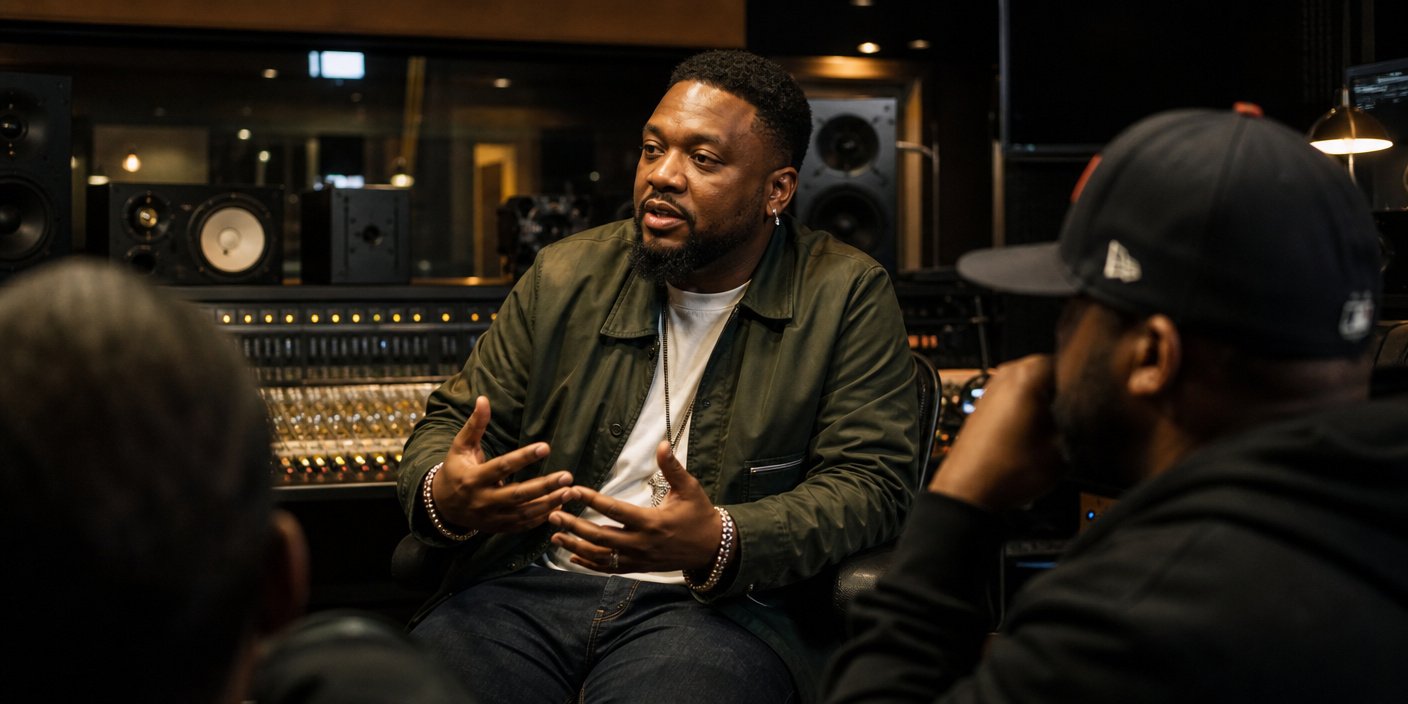
Kyambo “Hip-Hop” Joshua, the legendary A&R visionary who helped define the sound of Roc-A-Fella Records, has offered a provocative, granular analysis of rap’s hierarchy. In a wide-ranging discussion that has spanned numerous segments—most recently highlighted in his latest analytical deep dive—the industry veteran posits that Kanye West possesses a level of artistic scope that transcends the accomplishments of contemporaries Jay-Z, Drake, and Lil Wayne. Joshua’s perspective, rooted in his instrumental role in signing and developing West during his formative years, provides a rare, objective look at the distinction between a ‘rapper’ and an ‘artist’ in the modern era.
Key Highlights
- The A&R Perspective: Kyambo Joshua emphasizes that his judgment is based on the granular, day-to-day witnessing of West’s creative process, not just consumer consumption.
- Defining ‘Artist’ vs. ‘Rapper’: The core argument rests on the definition of an artist as someone who controls every facet of their sound, fashion, and cultural output, rather than solely lyrical prowess.
- The Roc-A-Fella Legacy: Joshua recontextualizes the early days of Roc-A-Fella, providing historical context on how West’s production vision forced a pivot in the label’s trajectory.
- Systemic Comparison: The analysis serves as a masterclass in how to evaluate music legends, shifting the conversation away from streaming numbers and toward long-term cultural and sonic design.
The Architect of the Sound: Redefining Artistic Greatness
To understand Kyambo “Hip-Hop” Joshua’s assertion, one must first understand his position in the industry. As an A&R (Artists and Repertoire) executive, his role was never to be a fan; it was to identify raw potential and nurture it into commercial and cultural viability. When Joshua speaks on Kanye West, he is not speaking as a listener who was influenced by an album—he is speaking as the person who was in the room when the albums were being constructed from the ground up.
The Shift from Lyricism to World-Building
For decades, the standard for ‘the best’ in hip-hop was anchored in lyrical density. This is where artists like Jay-Z, with his intricate wordplay, and Lil Wayne, with his relentless output and metaphoric dexterity, have historically dominated the conversation. Drake, too, mastered the art of melodic synthesis and mass-market relatability. However, Joshua’s argument for West centers on ‘world-building.’
Joshua contends that while Jay-Z is arguably the greatest rapper of his era, West is the superior artist because he functions as a creative director of his own reality. From the early soulful chops of The College Dropout to the industrial, stark maximalism of Yeezus, West’s ability to shift the sonic landscape of the entire genre remains, in Joshua’s view, unmatched. He argues that West doesn’t just adapt to the music industry; he forces the industry to reorganize around his current creative epiphany.
The Roc-A-Fella Crucible
It is impossible to separate Joshua’s analysis from his tenure at Roc-A-Fella. During the early 2000s, the label was defined by the sophisticated, aspirational aesthetic of Jay-Z. When West entered the fold, his energy was abrasive to the established ‘street’ ethos of the label. Joshua recalls the friction, noting that West’s desire to prove himself not just as a producer, but as a lead artist, was met with skepticism.
Joshua highlights that this ‘friction’ is exactly why West remains the standard. While Drake operates with unparalleled digital optimization and Lil Wayne thrived in the ‘mixtape era’ with unmatched volume, West’s output is defined by a series of radical, jarring, and ultimately influential pivots. Joshua points out that West’s refusal to stagnate—even at the risk of commercial alienation—is a trait he views as the hallmark of true artistic greatness.
The Future of Hip-Hop Analysis
Joshua’s comments arrive at a pivotal moment in the music industry. As we move deeper into an era of AI-generated content and algorithm-driven hits, the role of the ‘A&R’ is often misunderstood or undervalued. Joshua’s analysis serves as a reminder that the industry was built by individuals who could see the ‘big picture’ before the public could. By comparing the ‘big four’—West, Jay-Z, Drake, and Wayne—Joshua isn’t necessarily declaring a winner in a vacuum; he is providing a rubric for how we should evaluate greatness. He suggests that we should prioritize the artist’s ability to change the architecture of culture itself, rather than their ability to deliver the punchiest line or the most streamable chorus.
FAQ: People Also Ask
1. Why does Kyambo ‘Hip-Hop’ Joshua believe Kanye is better than Jay-Z?
Joshua argues from the perspective of artistic evolution. He maintains that while Jay-Z is a master of the craft of rapping and business, West’s ability to serve as a singular ‘creative director’ for his music, fashion, and cultural presence makes him a more comprehensive, transformative artist.
2. Is this comparison a slight against Drake or Lil Wayne?
Not necessarily. Joshua’s analysis is contextual. He acknowledges the massive commercial success and cultural dominance of both Drake and Lil Wayne, but categorizes their genius differently. He views them as titans of delivery and consistency, whereas he views West as a titan of conceptual design.
3. Why is the ‘A&R’ perspective important in this debate?
An A&R executive like Kyambo Joshua provides the ‘behind-the-scenes’ context. He understands the struggle of turning a demo into a record, the ego involved in the studio, and the logistical challenges of executing a vision. His opinion carries weight because it is rooted in the practical reality of record making, not just listener preference.
4. What does ‘Part 17’ refer to in these discussions?
‘Part 17’ typically refers to a specific, granular clip or segment from a longer, deep-dive interview series, often hosted on platforms like The Art of Dialogue or similar hip-hop investigative channels. It signifies the ongoing, exhaustive nature of these long-form industry conversations.